Thursday, February 13, 2020


VICTIM: Helen Potts
KILLER:  Carlyle W. Harris
1891


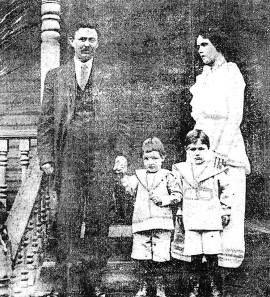
Young girls are often enthralled with young men they meet in the romance of a hot summer and act impulsively. Helen Potts is one such girl, who met a charming medical student and was romanced into a marriage for the purpose of sex on summers’ end.
 In 1891, a young finishing school student named Helen Potts was found dying in her dorm room; it was believed she had died from an overdose of morphine that she had gotten from her husband Carlyle Harris, a local medical student who she had recently married in secret because her mother disapproved.
            The two met in the summer of 1889 at a family cottage in Ocean Grove. Helen liked his “lightheartedness, carelessness, and brilliance.” They were inseparable all summer, and he proposed at the end of the summer. Carlyle’s mother refused to give permission for her daughter to marry; she was just too young, probably the reason Helen was able to be coerced into this hasty marriage in the
first place.  
            The two would not accept this decision and got married in secret at City Hall using the fake names, Charles Harris and Helen Neilson. Their deception was not discovered until August when Helen got ill.
            Harris had gotten what he wanted from his new wife, SEX, so he stopped seeing her until she came to him and told him she was pregnant.
            The scheme was discovered when Helen became ill and went to see her uncle, Dr. C.W Treverton. Mrs. Potts was told and came immediately. It was at this time she was told about the marriage. The cause of the illness was an operation performed by her husband. This surgery caused septic poisoning. Yes, the operation was an abortion.
            Mrs. Potts wanted the marriage made public and that the two have a proper wedding, but Harris insisted it would ruin his career and convinced Mrs. Potts to wait until after graduation. I guess Helen had no say in the decision. Harris convinced his mother-in-law to send her daughter to a boarding school. Perhaps this was his way of getting his inconvenient wife out of his daily life.
            Harris had bragged about his many conquests and confessed he had married other women just to get them to have sex with him."[He said he] could overcome any woman's scruples ... one method was to take a bottle of ginger ale and put in it a very large portion of whiskey, the other was to marry her, but under an assumed name. “ He had also performed abortions on many of these women.  Remember, he was not yet a real doctor and should not have been performing surgery. Could it be there were other women out there who had been butchered like Helen?
           
Helen suffered from terrible insomnia, so her husband gave her a prescription for morphine to help her fall asleep. One night, she awoke and told her schoolmates that she had a wonderful dream; they just told her to go back to sleep. Her response was “Yes, but I think it will be sleep of death.” Did she have a premonition?
            Shortly after, her schoolmates noticed she was breathing very heavily, and Helen complained of numbness throughout her whole body; eventually, she could not move. A doctor was ultimately called.  He used whiskey, atropine, digitalis, and electric shock and finally artificial respiration, but nothing could bring the girl around. She died the next morning.
The doctor found a pill bottle labeled “one before retiring” which was signed C.W.H. They brought Harris to the room where his dead wife was and all he said was, “My God, what can they do to me?” He was concerned because he was not yet a doctor and not supposed to be prescribing medication. The death of his wife seemed less important than his reputation. He said he had made sure she did not have enough pills to overdose. It was believed she had taken an overdose of her
sleeping medication…the morphine.
            Her mother convinced the authorities, though, that her daughter had a heart condition and that was the cause of the death. She was able to take her daughter home and bury her.
            But, the authorities were just not convinced, so they eventually had the body exhumed. In the autopsy, the heart was seen to be fine, but the brain was congested, a sign of opiate poisoning; in addition, there was morphine in the stomach and intestines.
            Under oath, Mrs. Potts admitted she lied about her daughter’s heart condition. She just didn’t want all the bad publicity and didn’t want the secret marriage talked about in the press.
            Harris had probably obtained the morphine when it was passed around, unsupervised, at his medical school during a lecture on the effects of morphine.
           
Harris was arrested. And even though his parents bought him the most expensive lawyers they could, he was still found guilty. Harris put forth numerous appeals, but when that didn’t work, he and one of his friends and supporters appealed to the Governor for a pardon or at least clemency. After doing his own research, the Governor decided to let the execution go forth.
            Harris appeared calm and rather theatric at his execution, “exaggerated and forced” almost. It “smacked of theatre.” He spoke of his own innocence and then was finally executed for what he had done to poor Helen Potts.
            Harris was so sure he had a foolproof plan to get sex from women, but Helen proved to be the one woman who would cost him his life.


Wednesday, January 29, 2020

Mary Cecilia Rogers


Mary Cecilia Rogers
           
On July 28, 1841, two men spotted what they thought was a bundle of clothing floating in the river. On closer inspection, it was discovered to be a beautiful young girl. She was brought to shore and the coroner was called. He saw finger marks on the girl’s throat. An ex-boyfriend, who had seen the news in the paper that Mary Rogers was missing happened to come to the shore of the river and unidentified the body as Mary Cecilia Rogers.
             Mary Rogers was a 20-year-old girl who lived in a boarding house run by her mother. She
worked in the cigar store Anderson’s Tobacco Emporium owned by Joe Anderson. It was a popular place for authors such as James Fenimore Cooper, Washington Irving, and Edgar Allen Poe. She was hired as a salesgirl, but her real talent was drawing men into the shop with her beauty and charm. The shop was crowded every day with young men who wanted to converse with the pretty girl and perhaps get themselves a date, but Mary was never interested.
She became a Manhattan celebrity, so when she disappeared the first time and failed to appear for work, it was front-page headlines. Her mother said she had found a suicide note. The coroner saw the note and said Mary was “fixed and unalterable determination to destroy herself.” But she returned, saying she had gone to visit friends and did not know what all the fuss had been about. The Sun was accused of manufacturing the story to sell papers, and John Anderson was accused of developing the scheme as a publicity stunt. Shortly after, she left the Emporium to go help her mother with the boarding house. While at the boarding house, she met a cigar cutter named Daniel Payne. The two developed a romantic relationship and finally got engaged.
One night in 1841, she told Daniel she was going to visit her aunt. There was an arrangement that he would come to pick her up, but that night there was a terrible thunderstorm and Daniel thought Mary would not want to go out in that weather and decided he would get her in the morning. Now there were no telephones or text messages at that time, so Mary had no idea he was not coming to get her. The next morning Daniel and Mary’s mother found out that not only wasn’t Mary at the aunt’s, but she had not even been expected. Where had she really gone?
  A group of men were walking by the river in Hoboken near Sybil’s Cave, a local tourist attraction, not an isolated location, when they saw a bundle in the river. They borrowed a boat and dragged from the river a lovely young woman. When they reached the shore, they called for the authorities, and the coroner said she had been strangled. Her clothes were torn, and her body looked beaten. It just so happened that one of Mary’s ex-boyfriends was looking for her and came upon the group surrounding her body and recognized her as Mary Cecilia Rogers. Solving this crime became a local obsession, and it ran on the front pages of all the papers. These newspaper editors knew Mary and wanted her murder solved, but they also saw headlines that sold papers.

A few days later, two boys found the rest of Mary’s clothing in a pile in the grasses. It was suspected that the clothing had been put there after the search had been done of the area. It had already been searched thoroughly and carefully by the investigators. White gloves were found in the pile, but they couldn’t be Mary’s because she was wearing white gloves when she was fished out of the river.
The police believed that a “roaming gang of thieves” could be the culprits, but they also took a very close look at the fiancĂ©. The couple had been arguing lately, and Mary had threatened to call off the wedding. But he had an alibi.
Frederica Loss, mother of the boys who had found the clothing, had her own tale to tell. She said that Mary and an unknown man had checked into the Nick Moore House that night. They had both gone out but had never returned. Later she heard screams from the woods. Why didn’t she tell the police her story sooner?
The papers made sure to keep the crime on the pages daily. They criticized the investigators and publicized the $750 reward posted by the Governor. The press even warned parents about letting their daughters come into the city, using Mary as an example of what can happen to them. These papers had at least one avid reader. Edgar Allen Poe devoured every word he could read on the death of Mary Rogers.
            On November 6, 1842, Frederica Loss was accidentally shot by one of her sons and lingered in pain, hallucinating for days. She told a slightly different story about what happened to Mary Rogers. Mary had come with a doctor who performed an abortion on Mary, but Mary died during the operation. Loss’s sons dumped the body in the river and later scattered her clothing in the area around the river. The sons were briefly charged, but there was not enough evidence to bring them to trial.
            One night, Daniel Payne sat on a bench near the spot Mary’s body had been found and took poison. He wrote a note saying, “To the World, I am on the very spot. May God forgive me for a misspent life.” Was this a confession? Was he on the spot where he had killed her? What did God need to forgive him for? The police would have been convinced that this was a confession and their mystery had been solved, except Daniel had an airtight alibi, so they were still left with questions with no answers.
           
Edgar Allen Poe’s obsession with the story led him to write “The Mystery of Marie Roget,” set in Paris where a naval officer was the killer. He wrote,” the death of a beautiful woman is, unquestionably, the most poetic topic in the world.” 
            It was then suggested that John Anderson killed her and had paid Edgar Allen Poe $5,000 to write his story to take the suspicion away from John. John claimed to be haunted by the ghost of Mary Rogers.
            The death of Mary Cecilia Rogers was never solved. The New York Herald published a poem about Mary:
                                                She moved amid the bland perfume’
That breathes of heaven’s balmiest isle;
Her eyes had starlight’s azure gloom
And a glimpse of heaven – her smile.


Thursday, January 16, 2020


What Happened to Bobby Dunbar?
On August 23, 1912, the Dunbar family went with their three boys to fish on Swayze Lake in Tennessee. When the parents, Lassie and Percy called to the children to come from the lake to have lunch, two of the boys came running immediately, but the youngest, 4-year-old Bobby was not with them. Initially, they were not worried. The assumed he was enjoying his time at the lake, so they called louder for him. No response, so the Dunbars contacted the authorities, and a search was initiated. The only evidence that the police could find that Bobby had been there were some small footprints leading away from the lake itself.
A $6,000 reward was offered ($160,000 in today’s money) and that got a lot of people interested in the search. The lake was dragged, alligators were caught and gutted to see if the child’s remains were inside, and even some threw dynamite in the lake, hoping the body, if it was there, would be shaken loose. The William Burns Detective agency became involved along with several psychics, but nothing.

Eight long months went by. The case was in the news in the few weeks after the child went missing, but like all cases like this, once the trail goes cold, the press is no longer interested. Just when it seemed the Dunbars would have to accept the fact that Bobby had probably wandered into the lake and was never coming home, a bombshell. In Mississippi, a child was found who resembled Bobby Dunbar. He was with a man named William Cantwell Walters, who claimed the boy was his nephew, the illegitimate son of his brother and a woman by the name of Julia Anderson. The boy’s name was Charles Bruce Anderson.  He said that she had left him with Walters, expecting it would be a few days, but the child was there for 13 months. When Julia was found, she agreed that the boy was her biological son. She did not agree, though, that it was the son of Walters brother. She claimed the father was a traveling salesman, a one-night stand who gave her $5 before he disappeared from her life.
Both Mrs. Dunbar and Julia Anderson went to Mississippi to bring her son home. The child was sleeping when Mrs. Dunbar arrived, and she was heard saying “I don’t know. I’m not sure.” He then woke up, looked around at the Dunbars and screamed. The child did not initially respond when called “Bobby,” and he didn’t seem to recognize Mrs. Dunbar, but she insisted he was her son.  The rest of the Dunbars agreed. They seemed to want to ignore that Bobby had a scar on his foot, and this child did not. That night, while giving “Bobby” a bath, Mrs. Dunbar exclaimed that the moles on the child matched the ones her son had.
Since King Solomon was not available, they had to rely on a judge to decide who this little boy would go home with. And, he decided that the child was Bobby Dunbar and not the son of Julia Anderson. This decision probably had a lot to do with the fact that Julia Anderson had three children out of wedlock, had left her son with Walters, not for 2 days but 13 months.
When “Bobby” came home, his hometown of Opelousas declared it a holiday and there were parties and parades.
Walter is eventually tried and convicted of kidnapping but after only two years in jail, his new attorneys appealed his conviction and it was overturned on a technicality. Fifteen years later he died of blood poisoning.
Julia went on to marry and have 8 children.
The boy was raised as Bobby Dunbar. Some say that Bobby knew he wasn’t Bobby and would visit the Andersons when he grew up. But he also told the media that he recalled the kidnapping by Walters.
In 2004, one of Bobby Dunbar’s granddaughters, Margaret Dunbar Cutright, got curious and had a DNA test done with a cousin of Bobby’s and her grandfather. The two men were NOT related. Eventually, it was determined that he was related to the Andersons.
I guess Julia was right; the boy was her son, and she had her son stolen from her, probably because Mrs. Dunbar presented a much better image of a mother than Julia did.
So…what happened to the real Bobby Dunbar? Did his parents do something to him, and then told the authorities he was missing? Did someone kidnap him from the lake that day, just not Walters? Or did this little unsupervised boy slip into the lake and drowned. Perhaps he did, and his wealthy parents found a way to raise him from the dead with the help of another neglectful mother and a little boy who wasn’t their own but was a good enough replacement?

References

Barclay, S. (2012, March 17). Bobby Dunbar. Retrieved from Historic Mysteries: www.historicmysteries.com/bobby-dunbar/
Bovsun, M. (2019, February 1). Bobby Dunbar's disappearance caused a mystery wasn't solved for 92 years. Retrieved from Daily News: www.nydailynews.com/news/crime/ny-news-bobby-dunbar-mystery-20190203-story.html


Monday, June 17, 2019

Lethal Conversations: AMY LYNN BRADLEY: LOST AT SEA?

Lethal Conversations: AMY LYNN BRADLEY: LOST AT SEA?: AMY LYNN BRADLEY: LOST AT SEA? One of the most fun vacations one can take is a cruise. It is a floating restaurant, hotel, and entert...

Lethal Conversations: AMY LYNN BRADLEY: LOST AT SEA?

Lethal Conversations: AMY LYNN BRADLEY: LOST AT SEA?: AMY LYNN BRADLEY: LOST AT SEA? One of the most fun vacations one can take is a cruise. It is a floating restaurant, hotel, and entert...

AMY LYNN BRADLEY: LOST AT SEA?

AMY LYNN BRADLEY: LOST AT SEA?

One of the most fun vacations one can take is a cruise. It is a floating restaurant, hotel, and entertainment center that occasionally drop you off in an interesting destination. But for the Bradley family, Ron, Iva, their son Brad and daughter Amy Lynn, their family cruise turned into a nightmare when their daughter just disappeared.
                On March 24, 1998, Amy Lynn Bradley was last seen asleep on the balcony of the family’s stateroom at about 5:30 a.m. by her father. He decided to let her sleep. When he went out to the balcony a half hour later, she was gone. The only items missing with her were her cigarettes and lighter. All her shoes were left behind. How far could she go barefoot? The family went on a search of the ship to locate their daughter.
                Four days before, the family boarded the Royal Caribbean’s Rhapsody of the Seas. The night before she went missing, Amy was seen at the night club with her brother. She wanted to stay while Brad returned to the stateroom leaving Amy with a band member named Yellow.
                The family asked the captain to not let anyone leave the ship when they docked that morning, but he did not want to upset the guests.  After the guests left, the ship was searched, but only the public rooms, not the individual staterooms.
                The Bradley’s felt that some of the crew had given “special attention” to Amy throughout
the cruise and perhaps she had been smuggled off the ship and sold into sexual slavery. Before the disappearance, three of the waiters made friends with Amy and when they arrived in Aruba, they asked Amy to go to Carlos & Charles, the last place that Natalee Holloway was seen. Amy told her father that these waiters gave her the creeps and she refused to go with them.
The night the waiters had asked Amy to go with them, the next day, all the photos that had been posted of Amy were missing, even though the photo supervisor remembered seeing them there.
The cruise line made very little effort to find Amy. Royal Caribbean said she was probably drunk and had fallen overboard. Eventual the Bradley’s had to go home, but Mr. Bradley and his son returned to Aruba.
                . He called the Bradley’s and described the tattoos and said he was 100% sure it was Amy. Later, the tourists identified the man with Amy as “Yellow” from the cruise ship.
Unsolved Mysteries
There were numerous sightings of Amy during the following years. Five months after the disappearance, two Canadian tourists saw a woman who looked like Amy on the beach in Curacao. She had the same tattoos as Amy, a Tasmanian devil, the sun, a Chinese symbol, and a lizard. They said Amy tried to talk to them, but her companions rushed her away. Amy walked into a nearby café, still looking back at the couple. One of the tourists saw Amy on
                In 1999, a naval ship docked in Barbados and one of the seamen went to a local brothel. He claimed to have seen a woman who told him she was Amy Lynn Bradley and had been kidnapped and needed help to get away from the people keeping her at the brothel. The seaman left and did not tell anyone since he was not supposed to be at that brother. It was not until he retired that he contacted the Bradley’s with his story. By the time they got to the brothel, it had burned down.
                Also, in 1999, a man named Frank Jones contacted the Bradley’s claiming a Columbia gangster was holding Amy in Curacao. Jones said he was a former Special Forces and offered to help find Amy for free. But as we know, there is no such thing as a free lunch!
                Jones said a female cook described Amy’s tattoos and repeated a lullaby Amy taught her. Jones sent two Navy seals to determine her location. At this point, Jones asked for money for the rescue. The Bradley’s requested to see proof that the Seals had found her. Jones supplied a photo, and the Bradley’s eventually gave him a total of $210,000.
               
He had Ron Bradley go to Florida to wait for the call that they had Amy. He sat in that motel room for a week waiting for that call. He finally got a call from one of Jones’s associates and determined that he and his family had been duped. Jones was arrested and plead guilty to mail fraud and got a 5-year sentence and restitution.
                Six years later, a woman, Judy Maurer claimed to see Amy in a bathroom in Barbados. Amy told her name, but two men came into the bathroom and talked loudly at Amy. They threatened Maurer and frightened, she hid in the stall until the men left. When she left the stall, Amy was still there, hunched over the sink. She said she was Amy from Virginia. At that point, the two men returned and crudely took Amy out of the bathroom. Maurer identified Amy to the FBI.
               
In 2005, the family received an email with a photo of a woman lying on a bed in underwear. An organization that locates victims of sex trafficking, thought it looked very much like Amy.
                In 2010, the turmoil from Hurricane Tomas unearthed a human jawbone on the beach in Aruba. It was tested to see if it was Natalee Holloway. It was not her, and  all testing stopped at that point and it was never tested to see if it was Amy or the nine other woman who had disappeared in the Caribbean.
                Amy has never been found but her family has not given up, hoping that she will come home eventually. Anyone who has sighted Amy Lynn Bradly or has information on her location, please inform the FBI.


REFERENCES

Bibliography

Gibbons, P. (n.d.). Shocking facts about Amy Lynn Bradley, the woman who disappeared at sea. Retrieved from Unbreakable Crimes.

Serena, K. (2018, March 7). The mysterious case of Amy Lynn Bradley, who vanished from a cruise ship. Retrieved from All That's Interesting.

Friday, June 14, 2019

MICHAEL SWANGO: KILLER DOCTOR

MICAHEL SWANGO: KILLER DOCTOR

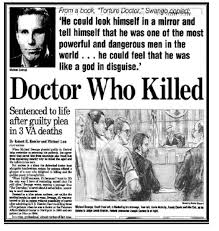
“He could look at himself in a mirror and tell himself that he was one of the most powerful and dangerous men in the world- he could feel he was a god in disguise…” portion of the personal notebook from Michael Swango: medical serial killer.

This quote might give us a glimpse into why Michael Swango killed at least 60 people…all those whose care was left in his hands. , but it is hard to understand the how-how did he get away with killing for so long? Was it due to a “broken system of background checks and the failure of hospital administrators to believe one of their own might be a killer”?
Michael Swango is what is called a medical murderer. His access to patients gave him easy access to victims. And being in the medical establishment assured him that he would not be that closely scrutinized.
            Michael grew up in a military family with a strict and alcoholic father. There was a great deal of tension at home, not only from the father who was a hard taskmaster when he was at home but also the mother who created her share of tension. She saw Michael as exceptional, compared to his other brothers. She felt Michael would be underchallenged in the local high school, so she sent him to Christian Brothers High School. His brothers were sent to the local public high school; this certainly sent a message to the other brothers that somehow they were lesser minds than their brother. This couldn’t help but create tension among the brothers.
            Michael not only excelled academically, but he read music, sang, played the piano and
clarinet and eventually played in the Quincy Notre Dame Band and the Quincy College Wind Ensemble. He graduated as the 1972 class valedictorian and went on to Milkin University, in Decatur, Illinois, on a full music scholarship.
            He made top grades his first two years, but then, when his girlfriend dumped him, he withdrew from his academics, and the summer after his second year, he quit school altogether and joined the Marines. When he returned from the Marines, he had decided to become a doctor, so he returned to Quincy College to take classes in chemistry and biology. In his record, he lied and included a Bronze Star and Purple Heart that he did not have. He also developed a fascination with poisons and did heavy research on the subject.
            One has to wonder what happened to him in the Marines that not only made him want to be a doctor but to develop such an interest in poisons. From then on, his focus was to get into medical school and gain access to patients; in addition, he spent most of his time researching poisons. This is the time period when he developed an interest in violent deaths and began to keep a scrapbook of stories from the newspaper on car accidents and violent deaths.
            As side employment, Michael got a job as an ambulance driver, which gave him access to the real thing, violence in the flesh. He never missed a chance to go out on a run to car accidents, even if it meant missing classes and postponing studying.
            At Southern Illinois University Medical School, there were mixed reviews from his professors. He took unscrupulous shortcuts in projects and tests. It seems he was more interested in becoming a doctor than learning to be a doctor. The other students saw him as lazy, incompetent and strange, calling him Double O Swango, license to kill. What a prophetic nickname.
            He took a job as an EMT, having been previously fired from his job as an ambulance driver. The other EMTs noticed that when Michael made the coffee or brought in donuts for the crew, the staff got violently ill. His fellow EMTs set up a sting where they put a pitcher of iced tea in the break room and left it alone. After they were sure Michael had been in the room, they had it tested and found it laced with arsenic.  He was arrested, and arsenic and other poisons were found in his car. He was convicted of aggravated battery and received a sentence of five years.
When the law school dean reviewed the case, he concluded that the medical school should have more closely investigated Swango, but Michael had never been accused of any crime before, so this seems more like 20/20 hindsight. Attempted murder charges were considered but there was just not enough evidence. One would assume, though, that Michael’s medical career was over—right?
           
Well, when he was released from prison, he got a job at The State Career Development Center in Virginia, but lost it because he couldn’t resist working on his scrapbook of disasters on work time  His next job was as a lab tech at ATICoal where employees suddenly developed  numerous stomach pains. Michael was suspected, but he quit before anything could be done about it.
            In 1991, he changed his name to Daniel J. Adams and began working at Sanford USD Medical Center in Sioux Falls with forged documents, one being a fact sheet from the Illinois Department of Corrections changing his crime from a felony to a misdemeanor fistfight, another being a letter from the governor restoring his right to vote and letters from friends and colleagues saying he was now leading an exemplary life. All this allowed him to practice medicine; he was back in business, giving him the access to drugs and patients he needed.
            Things were going well at Sanford until he made the mistake of trying to join the AMA, whose background check was more detailed and came up with his conviction for poisoning, Sanford fired him.
            That Thanksgiving, the television program Justice Files ran an episode that included Michael. This certainly meant an end to any medical career for Michael, right? No, again he found a way back in.
            The AMA lost track of Michael, and he ended up at the State University of New York at Stony Brook School of Medicine. The first place he was posted was the VA Hospital in Northport where patients began dying at a distressing rate. The first one was on the very first day Michael arrived at the VA.  The mother of a girlfriend who had committed suicide began a campaign again Michael which eventually ended with his being fired from Stony Brook. The Dean of Stony Brook also got fired and alerted all 125 medical schools and 1, 000 teaching hospital about Swango.
            Since the last incident was in a VA hospital, it was considered a federal crime, so the FBI got involved. They found Michael working in Atlanta as a chemist and a warrant was issued for using false credentials to gain entry to a VA hospital. But before they could arrest him, he fled the country and ended up in Zimbabwe.
            There he got another job at a hospital again with forged documents. It seems like Michael could have made a healthy living as a forger since these documents were never questioned. Patients, again, began to die. The nurses were the first to become suspicious. Swango had a private stash of drugs and always had two syringes in his pockets, one hidden (not very well since all the nurses seemed to know about it) and the other in his hand.
            One patient had had his left foot amputated and was healing well. He was just there at the hospital waiting for a prosthesis donated by a charity. “Dr. Mike” came in one night and injected him with something. The patient grew numb but was still able to call the nurses who intervened and were able to save his life, but not his leg. The patient told the nurses who had done this to him, but Swango denied it and whined that he didn’t know why people were always accusing him with things like that.. The patient’s life was never the same and said he didn’t understand why he was not compensated for what “Dr. Mike” had done; after all the hospital had hired him.
The deaths at the hospital were traced to him, and he was terminated. He then hired a human rights lawyer to sue the hospital for wrongful termination. This could only be called the greatest case of hutzpah in the history of the world. A throng of Christian believers who had seen Michael as a gift from God there in Zimbabwe believed this termination was a witch hunt, not knowing the slaughter he had left behind in the states. This publicity was the last thing the Missionary Hospital wanted.
            Three years later, Michael applied to the Royal Hospital in Dhahran in Saudi Arabia, again using forged documents… let's just assume anywhere he goes from now on he uses forged documents.
            Back in the states, VA OIG Criminal Investigator consulted with a forensic psychologist to create a profile of Swango. The DEA combined focuses on the VA focusing on the crime of lying on an application in order to be able to prescribe narcotics.
            After a meticulous investigation and keeping a careful track of the airports, Michael was finally arrested by the Immigration and Naturalization Service at the Chicago-O’Hare airport on his way to Saudi Arabia. The hospitalized people of Saudi Arabia just became the luckiest patients on the planet.
            Because Michael knew they had evidence again him from the VA hospital and not wanting them to look into what he had done in Zimbabwe, he decided to plead guilty to defrauding the government. Sentenced to 3-5 years, the judge said he should not be allowed to prepare food or distribute drugs while in prison.
            During his sentence for misleading the government, the government was busy gathering evidence against him. They exhumed bodies and found poison. He had paralyzed one patient who later died.
Just as Michael thought his time in prison was over, the feds on Long Island charged him with three counts of murder, one count of assault, one of fraud and making false statements, and conspiring to commit wire fraud. Simultaneously he was charged in Zimbabwe with poisoning seven patient, five died.
            He originally pled not guilty but changed it to guilty to avoid the death penalty and extradition to Zimbabwe. He was sentenced to three consecutive life sentences.
            The story of Michael Swango should have been a wake-up call to the authorities around the world to do more meticulous background checks before any doctor get access to drugs and patients.


References

Dr. Joeseph Michael Swango. (n.d.). Retrieved from Murderpedia: https://murderpedia.org/male.S/s/swango-michael.htm
Gelten, L. (2018, SeptemberNew York Post.


8). How a murderous doctor was allowed to keep killing patients.
LeDuff, C. (2000, September 6). Man to admit murdering 3 L.I. patients. Retrieved from Murderpedia- The New York Times: https://murderpedia.org/male.S/s/swango-michael.htm
Leduff, C. (2000, September 7). Prosecutors say doctor killed to feel a thrill. New York Times.
Profile of Joseph Michael Swango: A License to Kill. (n.d.). Retrieved from ThoughtCo: www.thoughtco.com/profile-of-joseph-michael-swango-973127
The angel of mercy who turned out to be an angel of death. (1998, February 6). Retrieved from Murderpedia: https://murderpedia.org/male.S/s/swango-michael.htm


Olive Oatman

Olive Oatman The account of Olive Oatman is a story of a child who gets kidnapped by Indians and learns to adapt to her “new normal,” ...